Data Capture Methods for Studying Fully Autonomous Vehicles (FAVs) for Visually Impaired People (VIPs)
UX For Digital Civics
COMPANY
Study Abroad
ROLE
Researcher
EXPERTISE
UX Research
YEAR
2024
Project description
This project explored how emerging autonomous vehicle technology can become more inclusive for visually impaired people (VIPs). Working alongside PhD researcher Peter Hayton, our goal was to identify effective data capture methods to study how VIPs experience Fully Autonomous Vehicles (FAVs).
Target Users
Our focus was on visually impaired travelers (VIPs) who rely heavily on public transport for independence. These users value safety, consistency, and accessibility, making them key to understanding how autonomous public transport can support equitable mobility.
Challenge
There was very little existing research addressing the needs of visually impaired users in autonomous vehicles. Our challenge was to develop methods to capture their travel experience accurately and ethically, helping inform the next stage of Peter’s doctoral research on accessibility in FAVs.
Ways of Working
Worked collaboratively with Peter through hands-on workshops, field observations, and research synthesis sessions, ensuring each activity aligned with his academic goals and accessibility research standards.
Process
This category details the step-by-step approach taken during the project, including research, planning, design, development, testing, and optimization phases.
Understanding the Context
Analyzed Newcastle’s public transport system to identify gaps in accessibility and independence for VIPs.
Expert Interviews
Informal interviews with Peter and other accessibility advocates provided first-hand insight into trust, navigation, and independence challenges faced by VIPs.
Observational Research
Conducted observational walks to understand cane usage, identify stress points, and validate earlier insights.
Observational Research
Brainstormed potential data capture methods to quantify emotional and physical responses during travel—leading to our final solution, the smart cane.
Solution
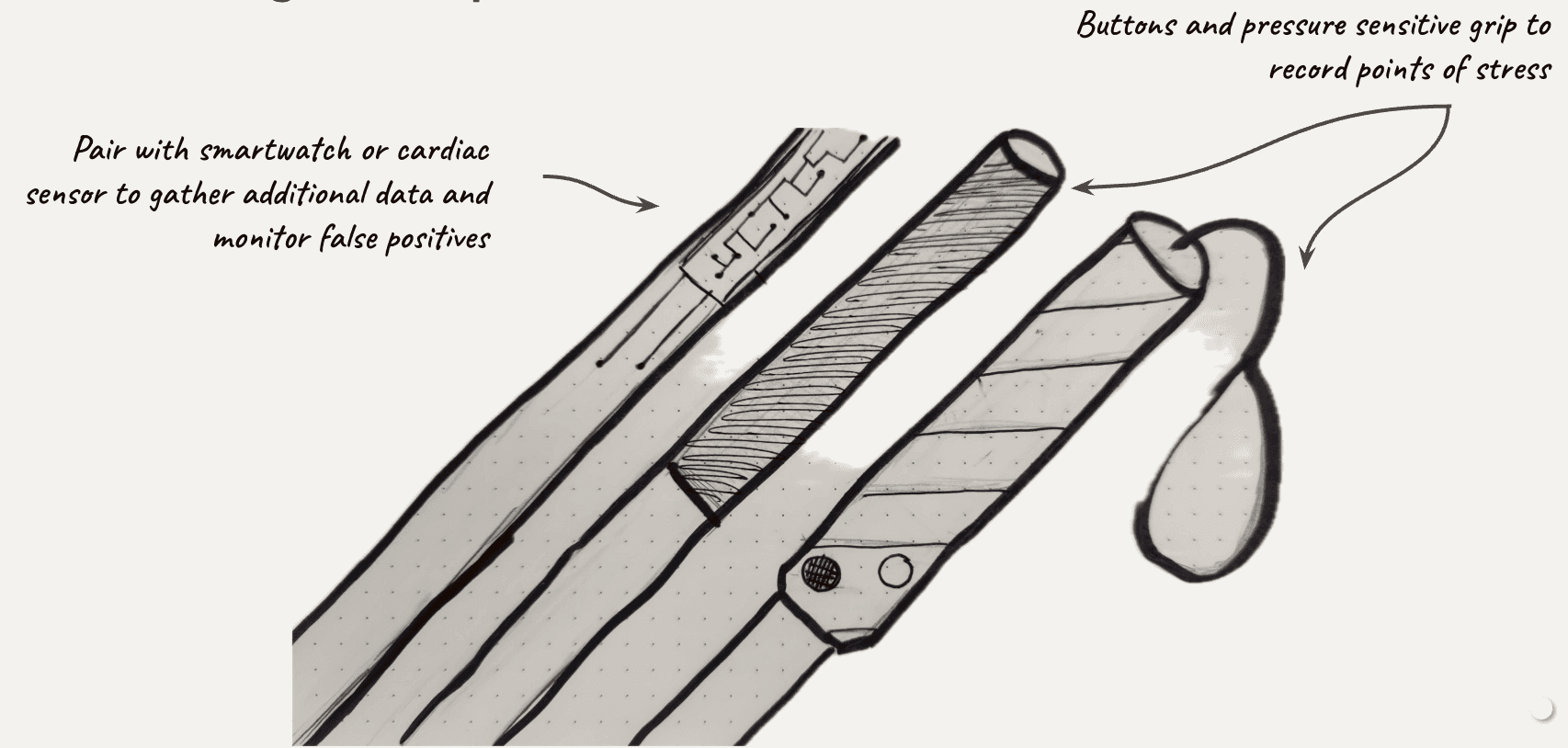
The resulting was a pressure-sensitive smart cane handle designed to collect real-time emotional and physical data during a VIP’s journey.
Pressure Sensors
Detect moments of stress or confusion through grip intensity.
Smartwatch Integration
Syncs biometric data (like heart rate) to validate stress levels.
Journey Mapping
Links data to travel routes, identifying environmental triggers or accessibility gaps.
This system allows researchers to quantify the VIP travel experience—transforming subjective feelings of stress or safety into measurable insights that can guide accessible FAV design.
Results
While still in the research phase, this project provided a validated concept that strengthened Peter’s PhD work and laid the groundwork for further testing.
Research Advancement
Helped refine Peter’s doctoral study by defining measurable methods for capturing VIP travel experiences.
Innovative Solution
Introduced a smart cane concept merging empathy-driven design with data collection technology.
Accessibility Insight
Revealed key barriers to independence in public and autonomous transport for visually impaired users.
Collaborative Impact
Empowered cross-disciplinary collaboration between design students and a PhD researcher to push accessibility research forward.